 |
| Dog communication motivation |

What science has to say about dogs
Showing posts with label human-animal interaction. Show all posts
Showing posts with label human-animal interaction. Show all posts
Sunday, October 28, 2012
Dogs, Canis familiaris, communicate with humans to request but not to inform

Social eavesdropping in the domestic dog
 |
| Canine Eavesdropping |
A comparison of dog–dog and dog–human play behaviour
 |
| Dog-Dog vs Human-Dog Playing |
Abstract
In
the popular literature, it is often assumed that a single conceptual
framework can be applied to both dog–dog and dog–human interactions,
including play. We have, through three studies, tested the hypothesis
that dog–dog and dog–human play are motivationally distinct. In an
observational study of dogs being walked by their owners (N=402),
dogs which were walked together, and had opportunities to play with one
another, played with their owners with the same frequency as dogs being
walked alone. This finding was supported by a questionnaire survey of
2585 dog owners in which dogs in multi-dog households played slightly
more often with their owners than dogs in single-dog households. The
performance of dog–dog play does not, therefore, seem to suppress the
dogs' motivation to play with their owners as would be predicted if they
were motivationally interchangeable. In an experimental comparison of
dog–dog and dog–human toy-centred play, the dogs were more likely to
give up on a competition, to show and present the toy to their play
partner, if that partner was human. When two toys were available, dogs
playing with other dogs spent less time showing interest in both toys
and possessed one of the toys for longer, than dogs playing with people.
Overall, the dogs were more interactive and less likely to possess the
object when playing with a person. We conclude that dog–dog and
dog–human play are structurally different, supporting the idea that they
are motivationally distinct. We therefore suggest there is no reason to
assume that the consequences of dog–dog play can be extrapolated to
play with humans.
Dog behaviour on walks and the effect of use of the leash
 |
| Is this really necessary? |
Abstract
This
paper describes how often pet dogs interact with other dogs, people and
the environment, whilst being walked. Such interactions may involve
aggression or the transmission of infectious disease. We also assessed
the effect of the use of a leash as a modifier of these outcomes. In
study one, the behaviour of pet dogs being walked in popular public
walking areas was observed (286 observations). Interactions with people
were much rarer than interactions with dogs. Multivariable modelling
suggested that percentage duration spent sniffing the ground was
associated with the UK Kennel Club Breed Type, and whether the dog was
observed urinating. Gundogs were observed to sniff more than other breed
types. In study two, dogs (n = 10) were filmed twice walking
along a pre-defined route, alternately once on leash and once off leash,
in order to assess the effects of leash use on interactions between the
subject dog and any other dog or person encountered. Multilevel
modelling suggested that if either dog was on the leash, then the
likelihood of an interaction with a dog occurring was reduced. There was
no evidence for statistical interactions between these variables,
therefore the effect of the leash on one dog did not seem to be
influenced by whether the other dog was on or off leash. We conclude
that in circumstances where interactions need to be prevented, such as
to reduce spread of infectious diseases during an outbreak, both dogs
should be leashed.
Survey of the use and outcome of confrontational and non-confrontational training methods in client-owned dogs showing undesired behaviors
 |
| Confrontational Behavior Modification |
Abstract
Prior
to seeking the counsel of a veterinary behaviorist many dog owners have
attempted behavior modification techniques suggested by a variety of
sources. Recommendations often include aversive training techniques
which may provoke fearful or defensively aggressive behavior. The
purpose of this study was to assess the behavioral effects and safety
risks of techniques used historically by owners of dogs with behavior
problems.
A 30-item survey of previous interventions was
included in a behavioral questionnaire distributed to all dog owners
making appointments at a referral behavior service over a 1-year period.
For each intervention applied, owners were asked to indicate whether
there was a positive, negative, or lack of effect on the dog's behavior,
and whether aggressive behavior was seen in association with the method
used. Owners were also asked to indicate the source of each
recommendation. One-hundred-and-forty surveys were completed. The most
frequently listed recommendation sources were “self” and “trainers”.
Several confrontational methods such as “hit or kick dog for undesirable
behavior” (43%), “growl at dog” (41%), “physically force the release of
an item from a dog's mouth” (39%), “alpha roll” (31%), “stare at or
stare [dog] down” (30%), “dominance down” (29%), and “grab dog by jowls
and shake” (26%) elicited an aggressive response from at least a quarter
of the dogs on which they were attempted. Dogs presenting for
aggression to familiar people were more likely to respond aggressively
to the confrontational techniques “alpha roll” and yelling “no” compared
to dogs with other presenting complaints (P < 0.001). In
conclusion, confrontational methods applied by dog owners before their
pets were presented for a behavior consultation were associated with
aggressive responses in many cases. It is thus important for primary
care veterinarians to advise owners about risks associated with such
training methods and provide guidance and resources for safe management
of behavior problems.
Children and their pet dogs : How they communicate
 |
| Children and dogs |
Abstract
The
research of ethologists has provided a better understanding of the
mechanisms, role and development of communication behaviour between
young children and their peers. However, little is known about the
communication systems between children and their pets. A study of these
relational systems would be needed to understand how the child interacts
with his whole environment.
The present study is based on
the analysis of video tapes filmed during spontaneous interactions
between children from 2 to 5 years of age with their pet dog (N = 45) in
their home environment. Inventories were made of the child and dog
behaviours during these interactions. The results have shown the
different dog behaviours induced by the child and the different child
behaviours induced by the dog. The links between these behaviours and
the variables which characterize both partners (age, sex, etc.) were
treated by factor analysis of correspondences. These data are discussed
in relation to the behavioural inventories of children and dogs with
their peers and conspecifics.
The Dog as a Model for Understanding Human Social Behavior
Abstract
The
traditional approach for studying the evolutionary emergence of human
social cognition is based on comparisons with apes and monkeys as model
species with a homologous relationship to other primates and humans.
Recently, however, research interest has focused on other species
offering analogous models for the evolution of human social cognitive
abilities. Here we suggest that convergent social evolution in dogs can
be used to model the early state of human social evolution, suggesting
that functionally analogous forms of many traits of the human behavioral
complex are present in dogs. We argue that the dog as a model species
is unique among domesticated species because (a) many aspects of dog
behavior are functionally analogous to the corresponding human traits,
(b) socialization to humans is a natural process in dogs, (c) comparison
with the ancestor is important for convergent modeling, and (d) the dog
represents a natural experimental model for studying human behavior.
A friend or an enemy? Dogs’ reaction to an unfamiliar person showing behavioural cues of threat and friendliness at different times
 |
| Dogs and Strangers |
Abstract
Responsiveness of adult pet dogs (Canis familiaris)
to an unfamiliar human was observed in two studies. Subjects were faced
with an approaching woman (Stranger) who showed definite signs of
friendliness and threat during alternate approaches. Observations
consisted of two episodes: the Stranger either approached the dog in
normal speed of walk while talking to it and finally petted it gently
(Friendly approach episode) or she moved slowly and haltingly and looked
steadily into the eyes of the dog without any verbal communication
(Threatening approach episode).
In the first study 30 dogs
of 19 different breeds were tested in the two episodes in a balanced
sequential order. The dogs acted appropriately according to the
different human behaviour cues. The order of the Friendly/Threatening
approaches had no significant effect on the dogs’ responsivity.
In
the second experiment 60 dogs of three breed groups (20 Belgian
shepherds, 20 retrievers and 20 sled dogs) were first ‘greeted friendly’
and then approached ‘threateningly’ by the same Stranger. Results show
significant breed specific differences in the responsivity when dogs
faced an apparent switch of the human behaviour cues. Compared to
retrievers and sled dogs, Belgian shepherds more frequently changed
their response, showing passive or active avoidance or sign of
aggression when approached threateningly.
While sex
differences were not found, breed comparisons suggest that selective
breeding (i.e. for hunting or shepherd work) influenced the dogs’
sensitivity to human social cues in different ways. Results also support
the hypothesis that human influence (domestication) has led to extreme
flexibility of the dogs’ situation-relevant behaviour while interacting
with an unfamiliar human.
Behaviour of smaller and larger dogs: Effects of training methods, inconsistency of owner behaviour and level of engagement in activities with the dog
 |
| Behavior of Smaller and Larger Dogs |
Abstract
The
owner's behaviour is regarded to be a possible cause of unfavourable
behaviour such as poor obedience or excitability in smaller dogs. The
aim of this study was to investigate whether owner behaviour such as use
of training methods, inconsistency in the owner's behaviour or
engagement in shared activities differs between owners of smaller
(<20 kg) and larger dogs (≥20 kg) and whether associations between
the owner's and the dog's behaviour in smaller dogs differ from those in
larger dogs. For this purpose, a questionnaire-based survey via postal
mailing was conducted in an urban and suburban population of pet dog
owners (response rate: 28%). Statistical analysis of 1276 questionnaires
involved descriptive statistics, Chi2-test, t-tests and Spearman correlations. Our results confirm that smaller dogs are seen as less obedient (P < 0.001), more aggressive and excitable (P < 0.001) and more anxious and fearful (P < 0.001). Smaller dog owners reported being more inconsistent in interactions with their dog (P < 0.001) and engaging less in training and play activities (P < 0.001) than larger dog owners. More consistent owner behaviour (rs = −0.4, P < 0.001) and more frequent engagement in training and play activities (rs = 0.4, P < 0.001)
correlated with better obedience in smaller dogs. No marked differences
were found in the types of training methods used with smaller and
larger dogs, but owners of smaller dogs reported slightly less use of
punishment (P = 0.007). In smaller and larger dogs, a more
frequent use of punishment was associated with increased aggression and
excitability (smaller: rs = 0.3, P < 0.001; larger: rs = 0.2, P < 0.001)
as was a more frequent use of reward-based responses to unwanted dog
behaviour such as calming or distracting the dog (rs = 0.2, P < 0.001).
The main result of our study was that increased anxiety and fear was
related to a more frequent use of punishment in smaller (rs = 0.2, P < 0.001)
but not in larger dogs. We conclude that smaller dog owners could
significantly improve obedience in their dogs by being more consistent
in interactions and engaging regularly in play and training activities
with them. Behavioural problems could be reduced by avoiding habits of
punishment that might reinforce fear or fear-related aggression.
Consistency of dogs’ reactions to threatening cues of an unfamiliar person

Abstract
Reliability
is one of the most important aspects of the behaviour observations
measuring personality traits in animals. The most fundamental way to
test reliability is the assessment of the test–retest consistency. On
the other hand, in situations where social interaction between a human
participant and the animal subject is at the scope of the study, the
behaviour of the humans in the test situation should be restricted by a
set of rules. However, if more than one experimenter participates in the
observations, the similarity of the behaviour of different persons is
an important aspect of the reliability of the study.
In our
first study we investigated the consistency of dogs’ behaviour during
approach by a person in a friendly and in a threatening way, repeating
the test either immediately after the first test or at least 6 months
later. We found that the dogs’ sensitivity to the human's behavioural
cues in this situation proved to be consistent over repetition when the
second test was performed approximately 1 year after the first test, but
it was not the case when the time elapsed between test occasions was a
few seconds. The detailed analysis indicated that dogs performing
extreme behaviour (friendly or threatening) tended to show more
conservative responses than dogs showing intermediate reactions when the
stranger approached threateningly. Nonetheless, the reaction of the
dogs failed to be in accordance with the opinion of the owners about the
dogs’ behaviour in similar situations in everyday life.
In
the second study we examined the consistency of the dogs’ behaviour in
the same situation when confronted with two different unfamiliar persons
immediately after each other. The consistency of the dogs’ response to
the two experimenters was found to be reliably high.
In sum,
this test procedure proved to be reliable enough to be a valuable
measure of a definite part of the personality characters of dogs.
The effect of time left alone at home on dog welfare
 |
| Effects of Time Left Alone on Dog Welfare |
Abstract
The
aim of this study was to investigate the effect of time left alone on
dog behaviour and cardiac activity. Twelve privately owned dogs, with no
history of separation related behaviour problems, were video-recorded
on three different occasions when left alone in their home environment.
The treatments lasted for 0.5 h (T0.5); 2 h (T2) and 4 h (T4).
Video-recording started 10 min before the owner left the house and
continued until 10 min after the owner returned, so that interactions
between dog and owner as well as behaviour during separation could be
studied. Data on heart rate (HR) and heart rate variability (HRV) were
collected within the same time period in each treatment. In addition to
analysing behaviours separately, behaviours were also grouped together
and defined as new variables; physically active, attentive behaviour,
vocal, interaction initiated by owner and interaction initiated by dog.
There were no differences in behaviour between treatments at equivalent
time intervals until the owner returned, although a number of
differences were observed at reunion with the owner. Dogs showed a
higher frequency of physical activity (P < 0.05) and attentive behaviour (P < 0.01) in T2 (0.37 ± 0.07; 0.52 ± 0.08, mean frequency of occurrence/15 s ± SE) and T4 (0.48 ± 0.08; 0.48 ± 0.07) compared to T0.5 (0.20 ± 0.07; 0.21 ± 0.05). They also showed more tail wagging (P < 0.01) and interacted more with their owners (P < 0.01) in T2 (0.27 ± 0.08; 0.47 ± 0.09) and T4 (0.26 ± 0.04; 0.42 ± 0.09) compared to T0.5 (0.09 ± 0.04; 0.14 ± 0.03). After a longer time of separation, the dogs also showed higher frequencies of lip licking (P < 0.05) and body shaking (P < 0.05) at the owner's return (T0.5 = 0.09 ± 0.05; T2 = 0.24 ± 0.08; T4 = 0.27 ± 0.06 and T0.5 = 0.03 ± 0.01; T2 = 0.08 ± 0.03; T4 = 0.07 ± 0.01, respectively). There was a tendency for higher HR (P < 0.1) during the first and second minute after reunion in T2 (127.6 ± 1.25, mean bpm ± SE; 111.3 ± 1.24) compared to T0.5
(106.2 ± 1.06; 87.5 ± 1.02). According to the results of this study,
the effect of time left alone was shown by a more intense greeting
behaviour by the dog towards their owner as well as by a higher
frequency of physical activity and attentive behaviour when the owner
returned, already after 2 h of separation. Although this study cannot
distinguish between whether dogs were aware of the length of time they
were alone (but did not signal it) or whether they were unaware until
reminded of it by the return of their owner, it does confirm that dogs
are affected by the duration of time at home alone.
Saturday, October 27, 2012
Results of a follow-up investigation to a clinical trial testing the efficacy of clomipramine in the treatment of separation anxiety in dogs
 |
| Clomipramine and Separation Anxiety |
Abstract
The
objective of the study was to investigate the incidence of adverse
events and changes in behaviour after use of clomipramine to treat
separation anxiety in dogs. This study was a follow-up investigation to a
previously published clinical trial. In the main trial, dogs were
randomised in a double-blinded manner to receive placebo, standard
(1–2 mg/kg, q12h) or low (0.5–1 mg/kg, q12h) dosages of clomipramine for
2–3 months. All dogs received behavioural therapy. Follow-up
questionnaires were completed in 76 out of 89 dogs between 5.5 and 16
months after completion of the main trial.
Post study, 12
dogs at one site received clomipramine long term (>13–16 months). The
clomipramine was tolerated well, no dogs had worsening of their
behaviour and behaviour improved further in 10 (83%) dogs.
An
additional 16 dogs received clomipramine and/or other drugs for up to
30 weeks and 48 cases received no drugs post trial. Acute worsening of
behaviour was noted in the first two weeks after stopping treatment in
three cases receiving low dose clomipramine, but in no cases in the
other groups. The worsening rate of separation anxiety >2 weeks after
stopping therapy was 13% of dogs that had received standard-dose
clomipramine, 15% of dogs that had received low dose clomipramine and
23% of dogs that had received placebo. The mean time to worsening was
longer in dogs that had received standard-dose clomipramine (37 weeks),
as compared to low dose clomipramine (11 weeks, P = 0.005) or placebo (11 weeks, P = 0.003).
In
conclusion, no undesirable long term effects were detected in the use
of standard-dose (1–2 mg/kg, q12h) clomipramine for the treatment of
separation anxiety in dogs. Abrupt withdrawal of a sub-optimal dose of
clomipramine (0
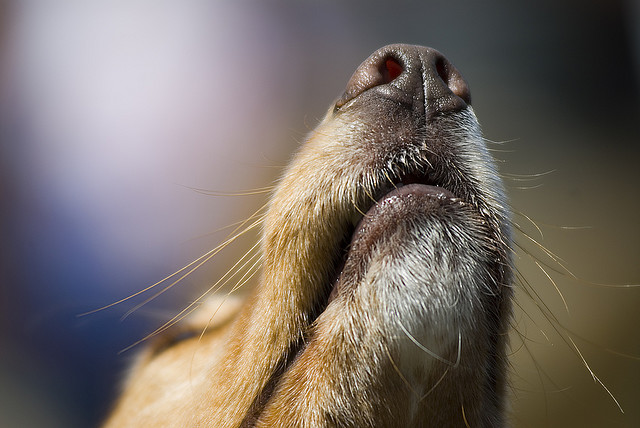
When dogs seem to lose their nose: an investigation on the use of visual and olfactory cues in communicative context between dog and owner
 |
| Canine Olfaction |
Abstract
In
two experimental studies, we observed whether dogs rely on olfactory
and/or visual information about the hiding place for food in a
two-choice test. However, for some dogs direct olfactory (smelling the
food) or visual (observing of the food being hidden) experience has been
contradicted by human pointing (a well-known communicative gesture for
the dog) to the ‘incorrect’ hiding place. We have found that dogs were
able to use both olfactory and visual cues efficiently to choose above
chance in a choice situation when there was no human cueing. However, in
other experimental groups the dogs tended to choose the bowl pointed at
by the human. This change in their behavior was more pronounced if they
had only olfactory information about the location of the food. In
contrast, if they had seen where the food was placed, dogs were more
reluctant to follow the pointing gesture, but even so their performance
worsened compared to the case in which they saw only the bowl baited.
These
results give further support for the hypothesis that dogs regard the
pointing gesture as being a communicative act about the placing of the
food, but they do not rely on this gesture blindly and they can modify
their behavior based on visual experience related directly to the hiding
of the food. Further, contrary to general expectations dogs rely in
this situation, only to some degree on olfactory cues.
Does training make you smarter? The effects of training on dogs’ performance (Canis familiaris) in a problem solving task
 |
| Benefits of Dog Training |
Abstract
This
study investigates the influence of training experiences on dogs’
performance in a problem solving task, namely opening a box to obtain
food. One hundred and eighteen dogs allocated to two different groups
according to their training experience (no/basic training vs high level
training) were tested. In each group the dogs saw the researcher
manipulating either the paw-pad or the lid, prior to being allowed free
access to the apparatus. No effect of the locus of manipulation was
observed. However, there was a strong effect of training on the dogs’
performance regardless of manipulation condition. Compared to untrained
dogs, highly trained dogs were more successful in opening the box and
spent significantly more time interacting with the apparatus; whereas
untrained dogs spent significantly more time looking back at their
owners and the researcher.
These results indicate that high
levels of training improve dogs’ problem solving ability, with dogs
appearing to be more proactive in the their interaction with novel
objects.
Imitation and emulation by dogs using a bidirectional control procedure
 |
| Carrie the Dancing Dog |
Abstract
A
successful procedure for studying imitative behavior in non-humans is
the bidirectional control procedure in which observers are exposed to a
demonstrator that responds by moving a manipulandum in one of two
different directions (e.g., left vs. right). Imitative learning is
demonstrated when observers make the response in the direction that they
observed it being made. This procedure controls for socially mediated
effects (the mere presence of a demonstrator), stimulus enhancement
(attention drawn to a manipulandum by its movement), and if an
appropriate control is included, emulation (learning how the environment
works). Recent research with dogs has found that dogs may not
demonstrate imitative learning when the demonstrator is human. In the
present research, we found that when odors were controlled for, dogs
imitated the direction of a screen-push demonstrated by another dog more
than in a control condition in which they observed the screen move
independently while another dog was present. Furthermore, we found that
dogs would match the direction of screen-push demonstrated by a human
and they were equally likely to match the direction in which the screen
moved independently while a human was present.
Canine Aggression Toward Familiar People: A New Look at an Old Problem

Training methods and owner–dog interactions: Links with dog behaviour and learning ability
 |
| Training methods and owner-dog interactions |
Abstract
The
methods by which owners train their pet dogs range widely, with some
exclusively using rewards, and others using a combination, or only
punishment-based methods. This paper examines links between the way in
which owners reported to have trained their dogs and observations of the
dogs’ subsequent behaviour. It also explores associations between
behaviour of owner and dog when tested in their own home. A total of 53
owners were surveyed about their preferred methods for training each of
seven common tasks, and were each filmed interacting with their dog in a
series of standardised scenarios. Dogs owned by subjects who reported
using a higher proportion of punishment were less likely to interact
with a stranger, and those dogs whose owners favoured physical
punishment tended to be less playful. However, dogs whose owners
reported using more rewards tended to perform better in a novel training
task. Ability at this novel task was also higher in dogs belonging to
owners who were seen to be more playful and who employed a patient
approach to training. This study shows clear links between a dog's
current behaviour and its owner's reported training history as well as
the owner's present behaviour. High levels of punishment may thus have
adverse effects upon a dog's behaviour whilst reward based training may
improve a dog's subsequent ability to learn.
Dog's gaze at its owner increases owner's urinary oxytocin during social interaction
Abstract
Oxytocin
(OT) has been shown to play an important role in social bonding in
animals. However, it is unclear whether OT is related to inter-species
social bonding. In this study, to examine the possibility that urinary
OT concentrations of owners were increased by their “dog's gaze”,
perhaps representing social attachment to their owners, we measured
urinary OT concentrations of owners before and after interaction with
their dogs. Dog owners interacted with their dogs as usual for 30 min
(interaction experiment) or were instructed not to look at their dogs
directly (control experiment). We observed the behaviors of owners and
their dogs during the experiments, and measured OT concentrations by
radioimmunoassay in urine samples from the owners collected just before
and 20 min after interaction with their dogs. Using a cluster analysis,
owners could be divided into two groups: one received a longer duration
of gaze from their dogs and reported a higher degree of relationship
with their dogs (LG); the other received a shorter duration of gaze and
reported a lower degree of relationship (SG). Urinary OT was higher in
LG than SG after usual interaction with their dogs, but not in the
control experiment. In the interaction experiment, a high correlation
was found in LG between the frequency of behavioral exchanges initiated
by the dog's gaze and the increase in urinary OT. We conclude that
interactions with dogs, especially those initiated by the dog's gaze,
can increase the urinary OT concentrations of their owners as a
manifestation of attachment behavior.
Disambiguating the “guilty look”: Salient prompts to a familiar dog behaviour
Abstract
Anthropomorphisms
are regularly used by owners in describing their dogs. Of interest is
whether attributions of understanding and emotions to dogs are sound, or
are unwarranted applications of human psychological terms to
non-humans. One attribution commonly made to dogs is that the “guilty
look” shows that dogs feel guilt at doing a disallowed action. In the
current study, this anthropomorphism is empirically tested. The
behaviours of 14 domestic dogs (Canis familiaris) were
videotaped over a series of trials and analyzed for elements that
correspond to an owner-identified “guilty look.” Trials varied the
opportunity for dogs to disobey an owner's command not to eat a
desirable treat while the owner was out of the room, and varied the
owners’ knowledge of what their dogs did in their absence. The results
revealed no difference in behaviours associated with the guilty look. By
contrast, more such behaviours were seen in trials when owners scolded
their dogs. The effect of scolding was more pronounced when the dogs
were obedient, not disobedient. These results indicate that a better
description of the so-called guilty look is that it is a response to
owner cues, rather than that it shows an appreciation of a misdeed.
Behavioral assessment and owner perceptions of behaviors associated with guilt in dogs
Abstract
Dog
owners ascribe guilt to dogs, and we explored this attribution with pet
dogs and their owners using a questionnaire and experiment. The
questionnaire found that the majority of owners perceive dog behavior as
guilty in certain situations and believe that dogs know when they have
committed a disapproved act. As a novel finding, the questionnaire
revealed that dog presentation of guilty behavior could lead owners to
scold dogs less.
The experiment aimed to investigate
the owner-reported anecdote that dogs sometimes greet owners displaying
guilty behavior. Owners claim to be unaware of a dog's misdeed and
assert it is the guilty behavior that informs them of the dog's
infraction. We studied whether dogs that were disobedient in owners’
absences showed associated behaviors of guilt (ABs) upon owners’ return
to a room. We also assessed whether owners could determine their dog's
disobedience by relying solely on the dog's greeting behavior.
Behavioral
analysis revealed no significant difference between obedient and
disobedient dogs in their display of ABs after having the opportunity to
break a rule in owners’ absences. Analyses at the individual level,
however, revealed a significant increase in cross situational
presentation of ABs only by dogs that transgressed in owners’ absences.
While owners appeared able to determine whether or not their dogs ate in
their absences, a subset of owners—those whose decisions were most
likely based solely on dog greeting behavior and not earlier
experiment-generated cues—were not better than chance in their
determinations. Taken together, our findings suggest that dog
presentation of ABs during greetings is not necessarily a reliable
indicator whether or not a dog engaged in a misdeed. The investigated
phenomenon appears to be very sensitive to the social condition, which
includes owner prior experience with their dog in specific contexts.
Subscribe to:
Posts (Atom)