 |
| Canine Eavesdropping |

What science has to say about dogs
Showing posts with label cues. Show all posts
Showing posts with label cues. Show all posts
Sunday, October 28, 2012
Social eavesdropping in the domestic dog

A friend or an enemy? Dogs’ reaction to an unfamiliar person showing behavioural cues of threat and friendliness at different times
 |
| Dogs and Strangers |
Abstract
Responsiveness of adult pet dogs (Canis familiaris)
to an unfamiliar human was observed in two studies. Subjects were faced
with an approaching woman (Stranger) who showed definite signs of
friendliness and threat during alternate approaches. Observations
consisted of two episodes: the Stranger either approached the dog in
normal speed of walk while talking to it and finally petted it gently
(Friendly approach episode) or she moved slowly and haltingly and looked
steadily into the eyes of the dog without any verbal communication
(Threatening approach episode).
In the first study 30 dogs
of 19 different breeds were tested in the two episodes in a balanced
sequential order. The dogs acted appropriately according to the
different human behaviour cues. The order of the Friendly/Threatening
approaches had no significant effect on the dogs’ responsivity.
In
the second experiment 60 dogs of three breed groups (20 Belgian
shepherds, 20 retrievers and 20 sled dogs) were first ‘greeted friendly’
and then approached ‘threateningly’ by the same Stranger. Results show
significant breed specific differences in the responsivity when dogs
faced an apparent switch of the human behaviour cues. Compared to
retrievers and sled dogs, Belgian shepherds more frequently changed
their response, showing passive or active avoidance or sign of
aggression when approached threateningly.
While sex
differences were not found, breed comparisons suggest that selective
breeding (i.e. for hunting or shepherd work) influenced the dogs’
sensitivity to human social cues in different ways. Results also support
the hypothesis that human influence (domestication) has led to extreme
flexibility of the dogs’ situation-relevant behaviour while interacting
with an unfamiliar human.
Consistency of dogs’ reactions to threatening cues of an unfamiliar person

Abstract
Reliability
is one of the most important aspects of the behaviour observations
measuring personality traits in animals. The most fundamental way to
test reliability is the assessment of the test–retest consistency. On
the other hand, in situations where social interaction between a human
participant and the animal subject is at the scope of the study, the
behaviour of the humans in the test situation should be restricted by a
set of rules. However, if more than one experimenter participates in the
observations, the similarity of the behaviour of different persons is
an important aspect of the reliability of the study.
In our
first study we investigated the consistency of dogs’ behaviour during
approach by a person in a friendly and in a threatening way, repeating
the test either immediately after the first test or at least 6 months
later. We found that the dogs’ sensitivity to the human's behavioural
cues in this situation proved to be consistent over repetition when the
second test was performed approximately 1 year after the first test, but
it was not the case when the time elapsed between test occasions was a
few seconds. The detailed analysis indicated that dogs performing
extreme behaviour (friendly or threatening) tended to show more
conservative responses than dogs showing intermediate reactions when the
stranger approached threateningly. Nonetheless, the reaction of the
dogs failed to be in accordance with the opinion of the owners about the
dogs’ behaviour in similar situations in everyday life.
In
the second study we examined the consistency of the dogs’ behaviour in
the same situation when confronted with two different unfamiliar persons
immediately after each other. The consistency of the dogs’ response to
the two experimenters was found to be reliably high.
In sum,
this test procedure proved to be reliable enough to be a valuable
measure of a definite part of the personality characters of dogs.
Saturday, October 27, 2012
When dogs seem to lose their nose: an investigation on the use of visual and olfactory cues in communicative context between dog and owner
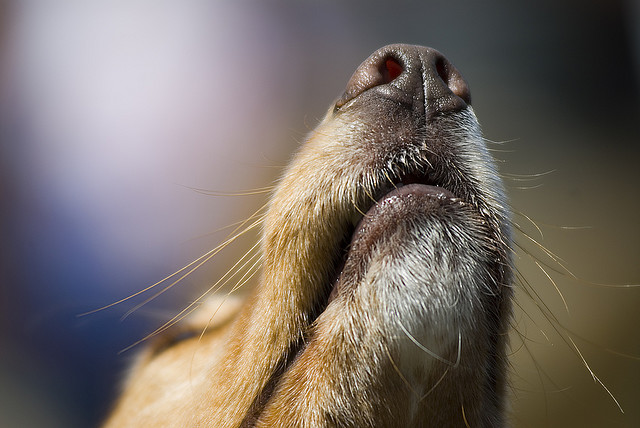 |
| Canine Olfaction |
Abstract
In
two experimental studies, we observed whether dogs rely on olfactory
and/or visual information about the hiding place for food in a
two-choice test. However, for some dogs direct olfactory (smelling the
food) or visual (observing of the food being hidden) experience has been
contradicted by human pointing (a well-known communicative gesture for
the dog) to the ‘incorrect’ hiding place. We have found that dogs were
able to use both olfactory and visual cues efficiently to choose above
chance in a choice situation when there was no human cueing. However, in
other experimental groups the dogs tended to choose the bowl pointed at
by the human. This change in their behavior was more pronounced if they
had only olfactory information about the location of the food. In
contrast, if they had seen where the food was placed, dogs were more
reluctant to follow the pointing gesture, but even so their performance
worsened compared to the case in which they saw only the bowl baited.
These
results give further support for the hypothesis that dogs regard the
pointing gesture as being a communicative act about the placing of the
food, but they do not rely on this gesture blindly and they can modify
their behavior based on visual experience related directly to the hiding
of the food. Further, contrary to general expectations dogs rely in
this situation, only to some degree on olfactory cues.
Disambiguating the “guilty look”: Salient prompts to a familiar dog behaviour
Abstract
Anthropomorphisms
are regularly used by owners in describing their dogs. Of interest is
whether attributions of understanding and emotions to dogs are sound, or
are unwarranted applications of human psychological terms to
non-humans. One attribution commonly made to dogs is that the “guilty
look” shows that dogs feel guilt at doing a disallowed action. In the
current study, this anthropomorphism is empirically tested. The
behaviours of 14 domestic dogs (Canis familiaris) were
videotaped over a series of trials and analyzed for elements that
correspond to an owner-identified “guilty look.” Trials varied the
opportunity for dogs to disobey an owner's command not to eat a
desirable treat while the owner was out of the room, and varied the
owners’ knowledge of what their dogs did in their absence. The results
revealed no difference in behaviours associated with the guilty look. By
contrast, more such behaviours were seen in trials when owners scolded
their dogs. The effect of scolding was more pronounced when the dogs
were obedient, not disobedient. These results indicate that a better
description of the so-called guilty look is that it is a response to
owner cues, rather than that it shows an appreciation of a misdeed.
Dogs choose a human informant: Metacognition in canines
Abstract

A Simple Reason for a Big Difference: Wolves Do Not Look Back at Humans, but Dogs Do
Abstract

Figurative and spatial information and search behavior in dogs (Canis familiaris)
Abstract
Domestic dogs (Canis familiaris)
were administered a variant of the delayed matching-to-sample task in
which they had to recover a hidden object and in which both spatial and
figurative information were kept constant at the outset of each trial.
Thereafter, either spatial (i.e. spatial condition) or figurative cues
(i.e. figurative condition) became relevant to solve the task. The
results revealed that dogs rapidly associated a spatial cue with the
recovery of the object. The discussion emphasizes the role of cognitive
and ecological constraints to account for the fact that figurative
information was not readily used as a cue to guide search behavior.
Dogs, Canis familiaris, communicate with humans to request but not to inform
Theory of mind in dogs?: examining method and concept.
Horowitz, A.
Theory of mind in dogs?: examining method and concept.
Theory of mind in dogs?: examining method and concept.
Learning and Behvior (impact factor:
1.52).
07/2011;
39(4):314-7.
DOI:10.3758/s13420-011-0041-7
Abstract
In line with other research, Udell, Dorey, and Wynne's (in
press) finding that dogs and wolves pass on some trials of a putative
theory-of-mind test and fail on others is as informative about the
methods and concepts of the research as about the subjects. This
commentary expands on these points. The intertrial differences in the
target article demonstrate how critical the choice of cues is in
experimental design; the intersubject-group differences demonstrate how
life histories can interact with experimental design. Even the
best-designed theory-of-mind tests have intractable logical problems.
Finally, these and previous research results call for the introduction
of an intermediate stage of ability, a rudimentary theory of mind, to
describe subjects' performance.
Reevaluating canine perspective-taking behavior.
Udell MA, Wynne CD
Reevaluating canine perspective-taking behavior.
Learn Behav. 2011 Dec ;39(4):318-23. doi: 10.3758/s13420-011-0043-5.
Abstract
Udell, Dorey, and Wynne (2011) demonstrated that both domesticated and nondomesticated canids-specifically, gray wolves-have the capacity to succeed on perspective-taking tasks, suggesting that dogs' ability to respond to the human attentional state is not a by-product of domestication alone. Furthermore, not all dogs were successful on the task. Instead, the occluder type used was a strong predictor of performance, indicating the important role of environment and experience for tasks of this type. Here, we address several commentaries reflecting on the methods and design of that study, as well as the interpretation of the results. We also discuss the positive shift toward more interactive approaches in the field of canine behavior and cognition. Finally, we question the functionality of describing canine social behavior in terms of theory of mind.
Subscribe to:
Posts (Atom)