 |
| Dog communication motivation |

What science has to say about dogs
Showing posts with label communication. Show all posts
Showing posts with label communication. Show all posts
Sunday, October 28, 2012
Dogs, Canis familiaris, communicate with humans to request but not to inform

Social eavesdropping in the domestic dog
 |
| Canine Eavesdropping |
Children and their pet dogs : How they communicate
 |
| Children and dogs |
Abstract
The
research of ethologists has provided a better understanding of the
mechanisms, role and development of communication behaviour between
young children and their peers. However, little is known about the
communication systems between children and their pets. A study of these
relational systems would be needed to understand how the child interacts
with his whole environment.
The present study is based on
the analysis of video tapes filmed during spontaneous interactions
between children from 2 to 5 years of age with their pet dog (N = 45) in
their home environment. Inventories were made of the child and dog
behaviours during these interactions. The results have shown the
different dog behaviours induced by the child and the different child
behaviours induced by the dog. The links between these behaviours and
the variables which characterize both partners (age, sex, etc.) were
treated by factor analysis of correspondences. These data are discussed
in relation to the behavioural inventories of children and dogs with
their peers and conspecifics.
Saturday, October 27, 2012
When dogs seem to lose their nose: an investigation on the use of visual and olfactory cues in communicative context between dog and owner
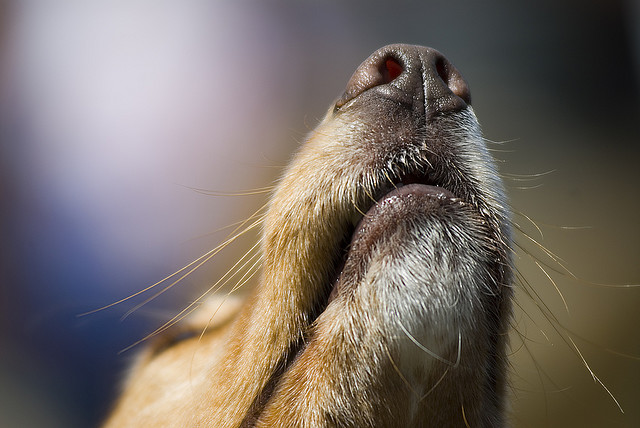 |
| Canine Olfaction |
Abstract
In
two experimental studies, we observed whether dogs rely on olfactory
and/or visual information about the hiding place for food in a
two-choice test. However, for some dogs direct olfactory (smelling the
food) or visual (observing of the food being hidden) experience has been
contradicted by human pointing (a well-known communicative gesture for
the dog) to the ‘incorrect’ hiding place. We have found that dogs were
able to use both olfactory and visual cues efficiently to choose above
chance in a choice situation when there was no human cueing. However, in
other experimental groups the dogs tended to choose the bowl pointed at
by the human. This change in their behavior was more pronounced if they
had only olfactory information about the location of the food. In
contrast, if they had seen where the food was placed, dogs were more
reluctant to follow the pointing gesture, but even so their performance
worsened compared to the case in which they saw only the bowl baited.
These
results give further support for the hypothesis that dogs regard the
pointing gesture as being a communicative act about the placing of the
food, but they do not rely on this gesture blindly and they can modify
their behavior based on visual experience related directly to the hiding
of the food. Further, contrary to general expectations dogs rely in
this situation, only to some degree on olfactory cues.
Dogs choose a human informant: Metacognition in canines
Abstract

Dogs, Canis familiaris, communicate with humans to request but not to inform
Physical size matters in the domestic dog's (Canis lupus familiaris) ability to use human pointing cues
Abstract
Researchers have reported differences between breeds of dogs in their ability to utilize human gestures (Wobber et al., 2009).
These reports could either be the result of underlying differences in
inherent communication abilities or differences in physical capacities
amongst breeds. One physical difference between breeds which may make a
difference in using visual cues is relative size. Larger dogs should,
all other things being equal, have greater inter-ocular distances and
this may improve their visual abilities for some tasks. This hypothesis
was tested in the present study by comparing the performance of larger
(>22.7 kg) and smaller (<22.7 kg) dogs on a pointing choice task.
Larger dogs did perform better on this task than smaller dogs (P = .03).
Researchers need to be careful when making comparisons between breeds
to first consider physical differences before assuming any inherent
cognitive differences.
Observations of scent-marking and discriminating self from others by a domestic dog (Canis familiaris): tales of displaced yellow snow
Abstract
Little is known about what stimuli trigger urinating or scent-marking in domestic dogs, Canis familiaris,
or their wild relatives. While it is often suggested that the urine of
other animals influences urinating and scent-marking patterns in canids,
this has not been verified experimentally. To investigate the role of
urine in eliciting urinating and marking, in this pilot study I moved
urine-saturated snow (‘yellow snow’) from place-to-place during five
winters to compare the responses of an adult male domestic dog, Jethro,
to his own and others' urine. Jethro spent less time sniffing his own
urine than that of other males or females, and that while his interest
in his own urine waned with time it remained relatively constant for
other individuals' urine. Jethro infrequently urinated over or sniffed
and then immediately urinated over (scent-marked) his own urine. He
marked over the urine of other males more frequently than he marked over
females' urine. The method used here can be extended to other species
for which experimental data are lacking. Though based on one dog, these
novel data may further our knowledge of the role of scent-marking in
territorial behavior and of sex differences in territory acquisition and
maintenance.
Learning and owner–stranger effects on interspecific communication in domestic dogs (Canis familiaris)
Abstract
Domestic
dogs are very successful at following human cues like gazing or
pointing to find hidden food in an object choice task. They solve this
kind of situation at their first attempts and from early stages of their
development and perform better than wolves. Most of the authors
proposed that these abilities are a domestication product, and
independent from learning processes. There are few systematic studies on
the effects of learning on dogs’ communicative skills. We aim to
evaluate the effect of extinction and reversal learning procedures on
the use of the pointing gesture in an object choice task. The results
showed that dogs stopped following the pointing cue in the extinction
and that they learned to choose the not pointed container in the
reversal learning. Results suggest that instrumental learning plays an
important role in interspecific communication mechanisms between humans
and dogs. In both experiments for half of the subjects the pointer was
the owner and for the rest was a stranger. A differential effect was
found: extinction was slower but reversal learning was faster when the
owner gave the cue. This data indicates that the relationship of the dog
with the person who emits the cue influences performance.
Effect of reinforcement, reinforcer omission and extinction on a communicative response in domestic dogs (Canis familiaris)
Abstract
There
is a controversy about the mechanisms involved in the interspecific
communicative behaviour in domestic dogs. The main question is whether
this behaviour is a result of instrumental learning or higher cognitive
skills are required. The present investigations were undertaken to study
the effect of learning processes upon the gaze towards the human's face
as a communicative response. To such purpose, in Study 1, gaze response
was subjected to three types of reinforcement schedules: differential
reinforcement, reinforcer omission, and extinction in a situation of
“asking for food”. Results showed a significant increase in gaze
duration in the differential reinforcement phase and a significant
decrease in both the omission and extinction phases. These changes were
quite rapid, since they occurred only after three training trials in
each phase. Furthermore, extinction resulted in animal behaviour
changes, such as an increase in the distance from the experimenter, the
back position and lying behaviour. This is the first systematic
evaluation of the behavioural changes caused by reward withdrawal
(frustration) in dogs. In Study 2, the gaze response was studied in a
situation where dogs walked along with their owners/trainers. These
results show that learning plays an important role in this communicative
response. The possible implications of these results for service dogs
are discussed.
Domestic Dogs
Domestic dogs (Canis familiaris) use visual attention cues when play signaling
Recent research has shown that dogs are able to recognize varying attentional states of humans (
[Call et al., 2003] and [Schwab and Huber, 2006]) and to use visual attention cues as an indication of a human's perceptual access (Virányi et al., 2006). The present research examines dogs’ use of visual attention cues when communicating with conspecifics in play.
Given
dogs’ success at producing and interpreting communicative and attention
cues of humans, a logical next step is to examine dogs’ abilities to
use attention cues when communicating to conspecifics. The present
research looks at 39 bouts of dyadic play in a natural setting.
Sequential behaviors and head direction of both dogs were noted
throughout the bouts. After coding, analysis considered the use of those
behaviors identified as “play signals” (invitations to play) or
“attention-getting behaviors” (acts which disrupt the partner's sensory
[visual, auditory, tactile] experience) with respect to the visual
attention cues of the recipient.
Of the 397 observed play signals, 376 were to a forward-facing audience (z = 5.25, n = 37 bouts, P
< 0.001). When play signals were used in combination with attention
getters, the actor preceded the play signal with the attention getter
more often than the inverse (χ2 = 9.52, df = 1, P < 0.01).
Dogs used attention getters more often when their partners were looking away than throughout the bouts (P[away] = 0.82, P[bout] = 0.34; z = 4.93, n = 33 bouts, P < 0.001). Further, dogs used more visual attention getters when their partner had their side to them (z = 1.93, n = 19 bouts, P = 0.0536), and dogs directed more tactile attention getters to dogs who were looking away or distracted (z = 2.37, n = 33 bouts, P
= 0.0178). When a partner was socially distracted, tactile attention
getters were used more often than visual attention getters (z = 2.22, n = 12 bouts, P = 0.0264).
Play
behaviors were differentially used according to the partner's posture.
Play signals were sent nearly exclusively to forward-facing
conspecifics; attention-getting behaviors were used most often when a
playmate was facing away, and before signaling an interest to play. In
addition, the mode of attention getter matched the degree of
inattentiveness of the playmate; stronger attention getters were used
when a playmate was looking away or distracted, and less forceful ones
when the partner was facing forward or laterally. The current evidence
provides support for the claim that dogs can use behavioral indications
of elements of attention in others to guide their own behavior.(Horowitz et al. 2009)
Breed differences in dogs’ (Canis familiaris) gaze to the human face
Abstract
Domestic dogs (Canis familiaris)
have been submitted to a vast process of artificial selection and to
date, there are hundreds of breeds that differ in their physical and
behavioral features. In addition, dogs possess important skills to
communicate with humans. Previous evidence indicates that those
abilities are related to the domestication process and are modulated by
instrumental learning processes. Very few studies, however, have
evaluated breed differences in the use and learning of interspecific
communicative responses. In Study 1 Retrievers, German Shepherds and
Poodles were compared in the acquisition and extinction of their gaze
toward the human face, in a conflict situation involving food within
sight but out of reach. The groups did not differ in the acquisition of
the response, but throughout the extinction phase Retrievers gazed to
the human significantly more than the other groups. In Study 2, similar
results were obtained in a test without any previous explicit training.
These results suggest that these three major popular breeds differ in
gazing to humans in a communicative situation.
Understanding of human communicative motives in domestic dogs
Helene Pettersson, Juliane Kaminski, Esther Herrmann,
Michael Tomasello
Understanding of human communicative motives in domestic
dogs
Applied Animal Behaviour Science, Volume 133, Issues 3–4,
September 2011, Pages 235–245
Abstract
Chimpanzees find it easier to locate
food when a human prohibits them from going to a certain location than when she
indicates that location helpfully. Human children, in contrast, use the
cooperative gesture more readily. The question here was whether domestic dogs
are more like chimpanzees, in this regard, or more like human children. In our
first study we presented 40 dogs with two communicative contexts. In the
cooperative context the experimenter informed the subject where food was hidden
by pointing helpfully (with a cooperative tone of voice). In the competitive
context the experimenter extended her arm towards the correct location in a
prohibitive manner, palm of hand out (uttering a forbidding command in a
prohibitive tone of voice). Dogs were successful in the cooperative condition (P = 0.005) but chose randomly
in the competitive condition (P = 0.221).
The second study independently varied the two characteristics of the
communicative gesture (the gesture itself and the tone of voice). In addition
to replicating dogs’ better performance with the cooperative gestures, this
study suggests that tone of voice and context had more effect than type of
gesture. In the context of food acquisition, domestic dogs, like human
children, seem more prepared to use human gestures when they are given
cooperatively.
Size communication in domestic dog, Canis familiaris, growls
A.M. Taylor, D. Reby, K. McComb
Size communication in domestic dog, Canis familiaris, growls
Animal Behaviour, Volume 79, Issue 1, January 2010, Pages
205–210
Abstract
In many species, body size is a key
determinant of the outcome of agonistic interactions, and receivers are
expected to attend to size cues when assessing competitors' signals. Several
mammal vocalizations, including domestic dog growls, encode reliable
information about caller body size in the dispersion of formant frequencies. To
test whether adult domestic dogs attend to formant dispersion when presented
with the growls of their conspecifics, we played recordings of resynthesized
growls where the size-related variation in formant frequency spacing was
manipulated independently of all other parameters. Subjects from three
different size groups (small, medium and large dogs) were presented with
playbacks of growls where formant frequencies had been rescaled to correspond
to a dog 30% smaller or 30% larger than themselves. While large dogs
systematically displayed more motivation to interact when growls simulated a
smaller intruder, small dogs did not respond differentially to the playback
conditions. However, the small dogs responded significantly less than all other
size groups to both playback conditions. Our results suggest that domestic dogs
are able to perceive size-related information in growls, and more specifically
that they are able to adapt their behavioural response as a function of the
perceived intruder's size relative to their own.
‘The bone is mine’: affective and referential aspects of dog growls
Tamás Faragó, Péter Pongrácz, Friederike Range, Zsófia
Virányi, Ádám Miklósi
‘The bone is mine’: affective and referential aspects of dog
growls
Animal Behaviour, Volume 79, Issue 4, April 2010, Pages
917–925
Abstract
A number of species are considered to
use functionally referential signals such as alarm calls or food-related
vocalizations. However, this particular function of communicative interaction
has not previously been found in canids. We provide the first experimental
indication that domestic dogs, Canis familiaris,
rely on context-dependent signals during interspecific agonistic encounters. We
recorded several sequences of growls from dogs in three different contexts:
during play, guarding a bone from another dog, and reacting to a threatening
stranger. We analysed the acoustic structure of the growls and additionally
performed playback tests in a seminatural food-guarding situation. We found
that play growls differed acoustically from the other two (agonistic) types of
growls, mainly in their fundamental frequencies and formant dispersions.
Results of the playback experiment showed that food-guarding growls deterred
other dogs from taking away a seemingly unattended bone more effectively than
growls recorded in the threatening stranger situation. We ruled out an effect
of the signaller's body weight on the subjects' responses. These results
provide the first evidence of context specificity of agonistic vocalizations in
the dog. We discuss the possible aspects of honesty and deception through
acoustic modulation of growls.
Understanding of human communicative motives in domestic dogs
Helene Pettersson, Juliane Kaminski, Esther Herrmann,
Michael Tomasello
Understanding of human communicative motives in domestic
dogs
Applied Animal Behaviour Science, Volume 133, Issues 3–4,
September 2011, Pages 235–245
Abstract
Chimpanzees find it easier to locate
food when a human prohibits them from going to a certain location than when she
indicates that location helpfully. Human children, in contrast, use the
cooperative gesture more readily. The question here was whether domestic dogs
are more like chimpanzees, in this regard, or more like human children. In our
first study we presented 40 dogs with two communicative contexts. In the
cooperative context the experimenter informed the subject where food was hidden
by pointing helpfully (with a cooperative tone of voice). In the competitive
context the experimenter extended her arm towards the correct location in a
prohibitive manner, palm of hand out (uttering a forbidding command in a
prohibitive tone of voice). Dogs were successful in the cooperative condition (P = 0.005) but chose randomly
in the competitive condition (P = 0.221).
The second study independently varied the two characteristics of the
communicative gesture (the gesture itself and the tone of voice). In addition
to replicating dogs’ better performance with the cooperative gestures, this
study suggests that tone of voice and context had more effect than type of
gesture. In the context of food acquisition, domestic dogs, like human
children, seem more prepared to use human gestures when they are given
cooperatively.
Subscribe to:
Posts (Atom)